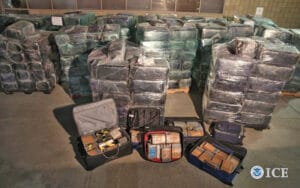
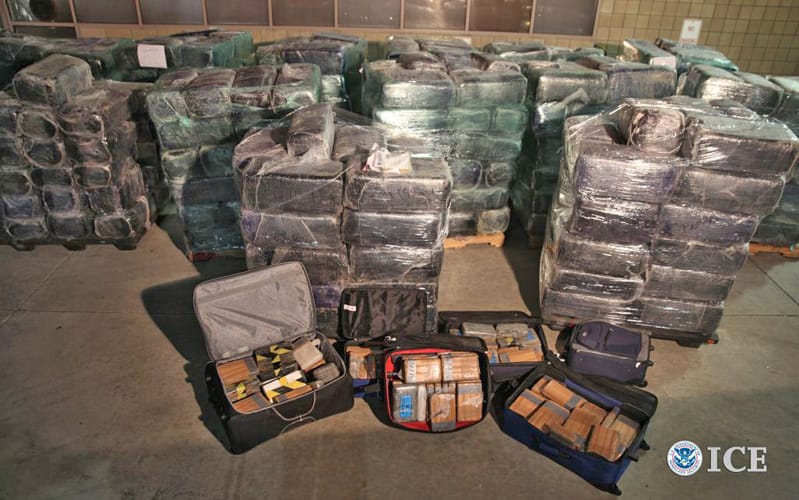
San Diego drug tunnels are used by drug traffickers to move millions of dollars worth of cocaine under the U.S.-Mexico border. In June 2026, authorities found a secret tunnel linking Otay Mesa in San Diego to Tijuana, Mexico. This tunnel was used to smuggle over 2,250 pounds of cocaine, worth about $45 million. Four people were arrested for drug trafficking and conspiracy.
The Otay Mesa drug tunnel is very advanced. It has a hydraulic lift to enter, a rail system to move drugs, and electricity and ventilation. It stretches more than 1,000 feet under the border and likely goes 800 feet into Tijuana.
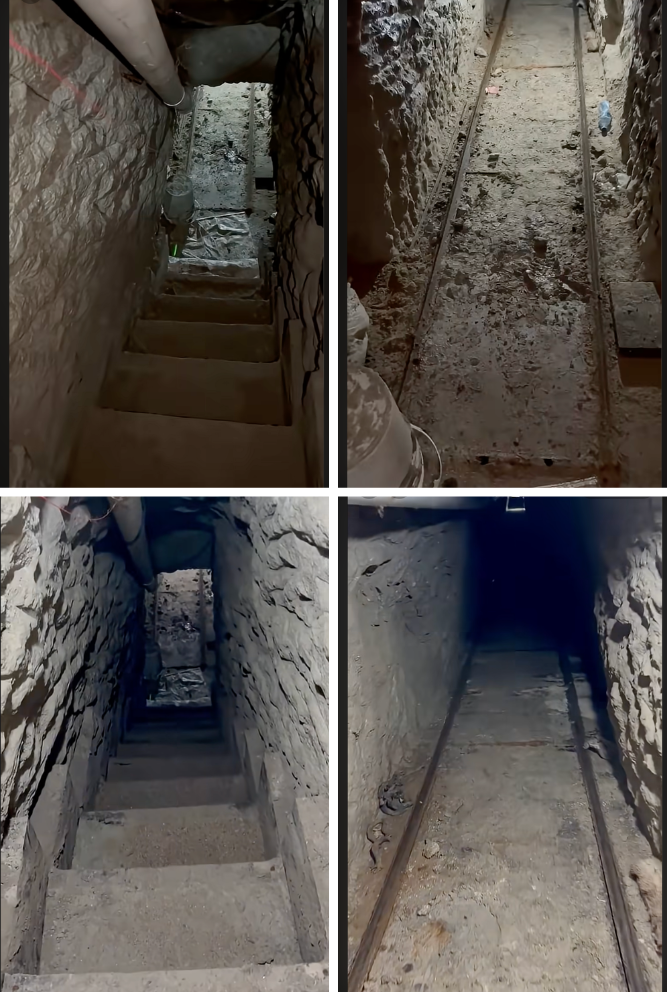
Screenshot by SDOCNews via US Attorney’s Office Southern District of CA
Estimated reading time: 10 minutes
Table of contents
Where was the drug tunnel found?
The drug tunnel found in San Diego connects to the Jalisco New Generation Cartel (CJNG), one of Mexico’s most powerful and violent criminal organizations. Otay Mesa is located in southern San Diego, CA, bordered by Chula Vista and the Otay River Valley. Accordingly, CJNG controls much of the drug flow into the United States and operates with extreme violence and sophisticated methods. CJNG drug trafficking is a well-known occurrence.
.jpg)
USDAgov, Public domain, via Wikimedia Commons
Since 1993, officials have discovered nearly 100 tunnels in Southern California, with about one-third classified as highly sophisticated. Consequently, traffickers improve their methods to avoid being caught cross-border smuggling. California has harsh penalties.
What is the Jalisco New Generation Cartel?
Jalisco New Generation Cartel (CJNG) Overview
Who They Are
CJNG is one of Mexico’s most powerful and violent cartels. Founded around 2010, it controls major drug trafficking routes into the U.S. and beyond.
Leadership & Structure
Led by Ruben Nemesio Oseguera Cervantes, aka “El Mencho,” CJNG uses a hierarchical and franchise model to expand influence across Mexico and internationally.
Criminal Activities
- Drug trafficking: fentanyl, cocaine, methamphetamine
- Money laundering and extortion
- Fuel theft, kidnapping, human smuggling
- Control of key ports for chemical imports
Violence & Terror Tactics
CJNG uses extreme violence to intimidate rivals and authorities, including public executions, assassinations, and attacks on police and officials.
Designated a Foreign Terrorist Organization by the U.S. State Department in 2025.
Impact on Border Security
CJNG’s vast resources allow it to build sophisticated tunnels and trafficking networks, posing ongoing challenges to U.S. and Mexican law enforcement.
Markedly, the Jalisco New Generation Cartel (CJNG) is known for using violence to control its territory. For example, in February 2026, Mexican forces carried out an operation that killed the cartel’s leader, El Mencho, and six others in Jalisco.
After this, CJNG fighters started violent attacks across the area. One of the attacks included setting a gas station on fire. A video shows cartel members lighting the gas station ablaze.
These attacks caused many injuries and deaths, including among police and cartel members, and even some civilians. The gas station fire is a clear example of how CJNG uses violence to send a message and keep control. Watch the video below of the incident.
How do drug tunnels work?
What makes the San Diego drug tunnel sophisticated? The Otay Mesa tunnel shows many advanced features. It is over 1,000 feet long and about 4.5 feet tall. The tunnel has strong walls to keep it from collapsing.
Inside, there is a rail system with carts to move drugs quickly. It also has electricity to power lights and ventilation to keep the air fresh. A hydraulic lift helps people enter and exit the tunnel safely.

base picture City of San Diego Geographic Information System (GIS), cropping and descriptors Rnieders., Public domain, via Wikimedia Commons
These features help traffickers move large amounts of drugs without being seen. The tunnel’s design makes it hard for law enforcement to detect and stop the smuggling.
Compared to simple tunnels, which are just holes dug underground, these sophisticated tunnels are like underground highways. They show how much effort and money traffickers put into their operations. Watch the video below for a view inside the drug tunnel found in San Diego in June 2026.
Have other Mexico drug tunnels been found?
This San Diego border tunnel 2026 is part of a long history of drug smuggling tunnels under the U.S.-Mexico border. Over the years, traffickers have built many tunnels, each one more advanced than the last, in an effort to continue the illegal drug trade.
Late in 2013, 17,292 pounds of marijuana and almost 325 pounds of cocaine were seized. As a result, the illegal drugs were linked to a sophisticated drug tunnel that connected a warehouse in Tijuana, Mexico, with a building in San Diego. The tunnel spanned the length of almost six football fields. Furthermore, authorities stated this was the first time cocaine was recovered with relation to drug smuggling in the San Diego area.
Drug Tunnels in the Last Decade
In 2015, authorities found a “super tunnel” between Tijuana and San Diego. It was about 880 feet long and had lights, electricity, and a rail system. This tunnel helped move 12 tons of marijuana. Consequently, officials made twenty-two arrests in connection with the tunnel.
One year later, in 2016, authorities discovered a tunnel in Calexico, California. Traffickers bought a house and built the tunnel right under it. The tunnel was about 1,245 feet long and had electricity and a rail system. Officers seized over 1,350 pounds of marijuana. The video below shows law enforcement cutting through the floor of the home to access the tunnel.
Then, roughly four years ago, in 2022, officials found another tunnel connecting a warehouse in Otay Mesa to a home in Tijuana. It was nearly 1,744 feet long and 61 feet deep. Authorities seized nearly 1,762 pounds of cocaine and arrested six suspects.
Each of these tunnels shows how traffickers keep improving their methods. CJNG’s use of extreme violence and intimidation supports its control over these smuggling networks. Law enforcement agencies continue to work hard to find and shut down these tunnels.
Cross-Border Tunnel Evolution Timeline (2015–2026)
2015: San Diego-Tijuana “Super Tunnel”
- Length: Approx. 880 feet
- Seizure: 12 tons of marijuana
- Features: Lighting, electricity, rail system
- Arrests: 22 suspects
2016: Calexico Tunnel
- Length: Approx. 1,245 feet
- Seizure: Over 1,350 pounds of marijuana
- Features: Electricity, rail system, built under a house
- Significance: First highly sophisticated tunnel in Calexico in a decade
2022: Otay Mesa Warehouse Tunnel
- Length: Nearly 1,744 feet
- Depth: 61 feet
- Seizure: Nearly 1,762 pounds of cocaine
- Features: Reinforced walls, rail system, electricity, ventilation
- Arrests: Six suspects
2026: Otay Mesa to Tijuana Tunnel
- Length: Over 1,000 feet (plus 800 feet into Tijuana)
- Depth: 55 feet (with hydraulic lift access)
- Seizure: Over 2,250 pounds of cocaine (~$45 million)
- Features: Hydraulic lift, rail and cart system, electricity, ventilation
- Arrests: Four suspects
Why do drug tunnels get rebuilt?
Building these tunnels takes a lot of money and planning. Traffickers spend millions to dig deep, build strong walls, and add features like rail systems and electricity.
CJNG generates billions of dollars annually from drug trafficking and other crimes. The cartel uses tunnels to move large amounts of cocaine, fentanyl, and methamphetamine safely and secretly. In comparison to other smuggling methods, tunnels reduce the risk of being caught at the border.

Uncredited police photographer, Public domain, via Wikimedia Commons
CJNG also controls key ports in Mexico, like the Port of Manzanillo, to import chemicals needed for drug production. Beyond drugs, CJNG profits from extortion, fuel theft, kidnapping, and human smuggling. Their vast resources allow them to invest heavily in tunnel construction and other trafficking infrastructure.
The cost and effort show how much traffickers believe they can profit. They weigh the risks of continuing to build and use illegal drug tunnels against the huge profits from drug sales.
How has law enforcement responded?
Finding these tunnels is very challenging for law enforcement. Traffickers build them deep underground and use strong materials to hide their work.
Authorities use many tools to detect tunnels. They rely on surveillance, tips, and undercover operations. Technology like ground-penetrating radar and seismic sensors helps find underground activity.
Multi-agency teams work together to stop tunnel smuggling. Groups like Homeland Security Investigations, the Drug Enforcement Administration, and U.S. Border Patrol share information and resources.
Despite these efforts, traffickers keep improving their tunnels. This creates a constant battle between smugglers and law enforcement.
How do drug tunnels affect the community?
These tunnels affect more than just law enforcement. They pose risks to border communities and public safety.
CJNG uses extreme violence and intimidation. The cartel publicly executes rivals, attacks law enforcement, and terrorizes civilians. In 2025, the U.S. State Department designated CJNG as a foreign terrorist organization.
CJNG’s violent tactics include assassinations, ambushes on police, and attacks on government officials. This violence supports their control over drug trafficking routes, including tunnels.
The tunnels help CJNG bring illegal drugs, weapons, and explosives into the U.S. This increases violence and crime in many areas.
Building and using tunnels also damages the environment. Digging underground can weaken soil and harm local ecosystems.
_Border_Wall_System_12_Mile_Project_(49785657111).jpg)
CBP Photography, Public domain, via Wikimedia Commons
The ongoing fight between traffickers and authorities shows how complex border security is. Both sides keep adapting, making it harder to stop illegal activity.
Strong laws and penalties exist to punish tunnel smuggling. Still, the problem continues, showing the need for new strategies and cooperation.
Looking Forward
All in all, cross-border tunnels remain a serious threat to border security and public safety. Traffickers keep building more advanced tunnels to move drugs and other illegal items.
As a result, law enforcement must stay alert and use new technology to find and close these tunnels. Additionally, cooperation between U.S. and Mexican authorities is also essential.
The fight against tunnel smuggling is ongoing. Public awareness and informed policies can help support efforts to protect communities.
Video of a drug tunnel discovered in 2014.
Frequently Asked Questions (FAQ)
Authorities discovered a sophisticated underground tunnel in 2026 connecting Otay Mesa, California, to Tijuana, Mexico. The Jalisco New Generation Cartel (CJNG) used it to smuggle over 2,250 pounds of cocaine worth about $45 million.
The Jalisco New Generation Cartel (CJNG) controls major drug trafficking routes into the U.S. Founded around 2010, the cartel uses extreme violence and advanced smuggling methods, including tunnels.
Traffickers build sophisticated tunnels with reinforced walls, electricity, ventilation systems, rail and cart transport, and hydraulic lifts. These features help them move large amounts of drugs quickly and avoid detection.
Law enforcement uses surveillance, intelligence gathering, ground-penetrating radar, seismic sensors, and undercover operations to find and shut down drug tunnels along the border.
Traffickers rebuild tunnels to keep secret routes open after authorities discover and close previous ones. Although costly, tunnels offer a safer, less detectable way to smuggle drugs.
Drug tunnels increase violence, crime, and environmental damage in border areas. They also challenge law enforcement and threaten public safety.
If you have any questions or want to report a typo, tip, or other concern, please do not hesitate to message DOPE Quick Reads.