
Dr. Catherine Forest, a proponent of the right to die, has assisted numerous terminally ill patients with ending their lives by prescribing aid-in-dying medication. She strongly supports the End of Life Option Act that went into effect in 2016. This law allows “an adult diagnosed with a terminal disease, who meets certain qualifications, to request the aid-in-dying drugs from their attending physician.” This practice is known as medical aid in dying (MAiD) or physician-assisted suicide.
Estimated reading time: 6 minutes
Table of contents
Dr. Catherine Forest shares her experience involving her husband’s request to use the End of Life Option Act
Dr. Forest recently shared her experience following her husband’s request to utilize medical aid in dying. Their relationship had been strong, and Dr. Forest immediately understood her husband’s reasoning. Will Forest had been diagnosed with amyotrophic lateral sclerosis (ALS), a terminal illness, and his decline progressed exceptionally quickly. His physicians informed him “that he was going to die by choking or suffocating.”

Dr. Catherine Sonquist Forest Photo by Compassion and Choices
Will admitted to his wife, Dr. Forest, that if he had not learned about the aid-in-dying law through her, he “would be living every last day of [his] life absolutely terrified of dying this way.” Although Will’s primary health care network was Catholic and unable to provide the life-ending medication, they got him into another hospital. This allowed him to receive the needed life-ending medicine.
How does the End of Life Option Act work?
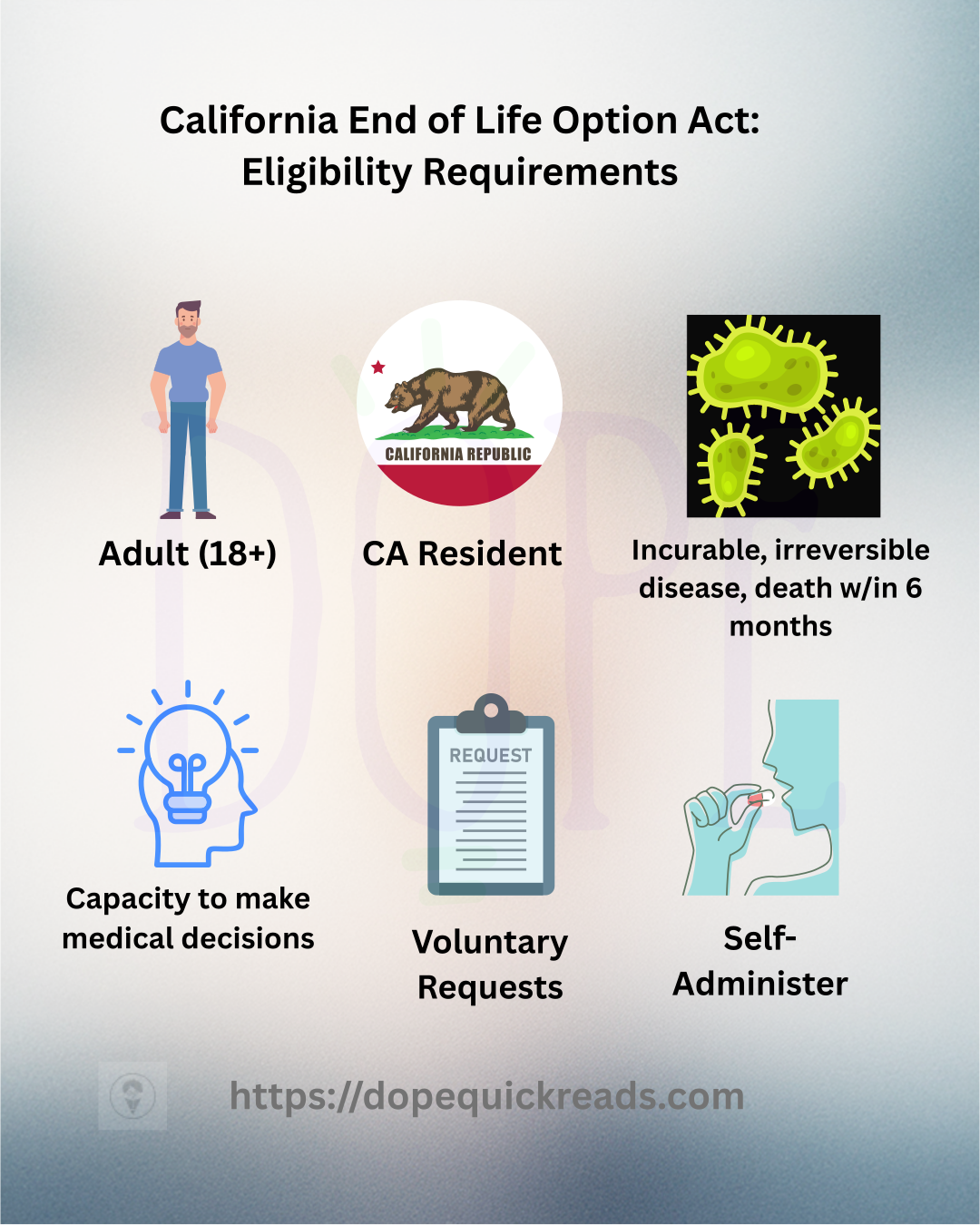
The End of Life Option Act, enacted in 2016, allows “an adult diagnosed with a terminal disease, who meets certain qualifications, to request the aid-in-dying drugs from their attending physician.” To qualify, a person must:
- Be an adult (18 years or older)
- Be a California resident (with no minimum timespan required)
- Have a diagnosis from the attending physician of an incurable and irreversible disease that will, within reasonable medical judgment, result in death within six months
- Have the capacity to make medical decisions as determined by two physicians
- Make voluntary requests (two oral, one written) for a prescription for aid-in-dying drugs without influence from others
- Be able to self-administer the aid-in-dying drug (by ingestion: either by mouth or through PEG or rectal tube)
The law includes several safeguards. Physicians must determine that the person has the capacity to make informed medical decisions. They must ensure the patient is not being coerced. The patient must be informed of alternative options, such as palliative care. The diagnosis and prognosis must be confirmed by a second physician. Notably, the person must make two oral requests, at least 48 hours apart. This is a reduction from the original 15-day waiting period. They must also submit a written request witnessed by two adults.
The End of Life Option Act allows health care providers who “object for reasons of conscience, morality, or ethics” to decline to participate in physician-assisted suicide. Additionally, providers may not be subject to “civil, criminal, administrative,” or other penalties for refusing to participate. However, as of 2022, physicians who choose not to participate must inform the patient of their decision and transfer medical records upon request. Health care providers are also prohibited from engaging in false, misleading, or deceptive practices relating to their participation in medical aid in dying.
Legislative updates and evolution of the Act (2016-2025)
Since its inception in 2016, the End of Life Option Act has undergone several significant changes:
- 2018 (AB282): Governor Brown signed an amendment to protect patients and healthcare providers from prosecution when acting within the law.
- 2021 (SB380): The law was streamlined by reducing the waiting period between requests from 15 days to 48 hours. They also eliminated the final attestation form requirement. These changes took effect on January 1, 2022. This made access to physician aid in dying more practical and timely for individuals exercising their right to end-of-life options.
- 2025 (SB403): Legislation was passed to eliminate the sunset date for California’s End of Life Option Act, which would have expired on January 1, 2031. As of October 2025, this bill, which would make the End of Life Option Act permanent in California, has passed both the Assembly and Senate and was signed by Governor Newsom.
The law has also survived legal challenges. In the case of Ahn et al. v. Hestrin, filed on June 8, 2016 (just one day before the law was to take effect), opponents argued that the Act was unconstitutional. They claimed it was because it had been passed during a special legislative session on healthcare. After five years of litigation, the California Court of Appeal dismissed the case in November 2021. The court affirmed the constitutionality of the End of Life Option Act. This resolved some of the legal issues surrounding the right to die.
Data on implementation and usage
Nine years of extensive data collection show the law is working as legislators intended, with medical aid in dying being safely practiced in California. In 2024, 1,591 people received an aid-in-dying prescription. Of those, 1,032 took the medication and died. Over 92 percent were age 60 or older, and 94.8 percent were receiving hospice or palliative care. The data also showed that terminally ill adults with conditions such as ALS and terminal cancer were among those who chose to use the End of Life Option Act.
Dr. Forest says the entire experience caused her family to think “about people in other states who do not have authorized access to aid in dying.” Her husband had only two months between his diagnosis and death. She remarked,
Will knew he was dying. Having the option of medical aid in dying meant that instead of having to worry about what would happen – Would he choke or suffocate to death? – Will could decide for himself whether his own suffering was unbearable. He could focus on spending the time he had left with our children and other loved ones, rather than in a state of anxiety over the end
As of 2025, eleven states and the District of Columbia have similar medical aid-in-dying laws. Though, California is unique in having initially included a sunset provision.
The End of Life Option Act continues to provide terminally ill adults with the choice of death with dignity. This allows them to make deeply personal decisions about their end-of-life options. While physician-assisted suicide remains a topic of ongoing debate, the law in California has shown to be a compassionate approach to addressing the needs of those facing terminal illnesses.
In mid-August, 2025, Senator Catherine Blakespear, Senate District 38, held a forum regarding end-of-ife issues. Watch the full video below of Charting Your Own Exit: Medical Aid in Dying and Other End-of-Life Choices.
References
[i] Compassion and Choices, Catherine Sonquist Forest, M.D. (Nov. 21, 2022)
[ii] Center for Health Statistics and Informatics, End of Life Option Act (2022)
[iii] Compassion and Choices, Catherine Sonquist Forest, M.D. (Nov. 21, 2022)
[iv] Id.
[v] Health & Safety Code, End of Life Option Act 443 – 443.22 (Jun. 9, 2016)
[vi] Compassion and Choices, Catherine Sonquist Forest, M.D. (Nov. 21, 2022)
[vii] California Court of Appeal, Ahn v. Hestrin dismissal (Nov. 2021)
[viii] California Legislative Information, SB 380 (Eggman, 2021)
[ix] California Senate, SB 403 (Blakespear, 2025)
If you have any questions or want to report a tip or other concern, please do not hesitate to message DOPE Quick Reads.
[Article Note: This piece was originally published on NewsBreak and has been archived and transferred to DOPE Quick Reads to preserve its informational value. Original publication date: 2023-01-29. New Updates added 2025-10-17]
Read more stories that interest you

AB 3216: CA’s New Surprising Phone Ban for Schools
July 19, 2026
What is AB 3216? Assembly Bill 3216 (AB 3216), also called the Phone-Free Schools Act, will require every California school...

What Is the ‘Unity of Arenas’ Doctrine? Tehran’s New Strategy
June 10, 2026
“The Iranian regime no longer enjoys immunity,” said former Israeli Prime Minister Naftali Bennett, describing his plan to strike the...

5 Easy Ways to be Happy This San Diego Summer
June 9, 2026
Summer in San Diego, California, hits differently. If you haven’t experienced a true San Diego County summer, you’re in for...

Can San Diego Make Voting Mandatory in a Free Society?
June 9, 2026
Should we treat voting like jury duty? Many argue for and against why voting shouldn’t be mandatory. So far, only...

Baller Button: Really Convenient Value or Profit for Inequality?
June 6, 2026
What if you could pay to skip the line at your favorite restaurant? The “Baller Button” at Lighthouse Bagels &...

San Diego Drug Tunnel 2026: $45M Cocaine Seizure in Otay Mesa
June 4, 2026
San Diego drug tunnels are used by drug traffickers to move millions of dollars worth of cocaine under the U.S.-Mexico...

Bailey Szramowski – Sailor’s Death Exposes Navy’s Hidden Fentanyl Crisis
June 3, 2026
Bailey A. Szramowski, a U.S. Navy sailor assigned to the USS Abraham Lincoln, is federally charged with distributing fentanyl that...
Do You Hate Oceanside’s Crammed I-5/SR-78 Connection?
May 7, 2026
If you drive in Oceanside, you’ve probably noticed how crowded and slow the connection between Interstate 5 (I-5) and State...

Should Dating Apps Ask for STD Test Results? What San Diego County Should Know
April 29, 2026
In San Diego County, many people worry about STDs. Recently, a woman shared that a man she matched with on...

Epic AI Robot Dog: New Six-Figure Tech Can Make Life Better
April 23, 2026
Imagine a robot dog that can walk, swim, and even talk to you. The latest AI robot dog models are...
You Might Also Like
AB 3216: CA’s New Surprising Phone Ban for Schools
July 19, 2026
What is AB 3216? Assembly Bill 3216 (AB 3216), also called the Phone-Free Schools Act, will require every California school...
What Is the ‘Unity of Arenas’ Doctrine? Tehran’s New Strategy
June 10, 2026
“The Iranian regime no longer enjoys immunity,” said former Israeli Prime Minister Naftali Bennett, describing his plan to strike the...
5 Easy Ways to be Happy This San Diego Summer
June 9, 2026
Summer in San Diego, California, hits differently. If you haven’t experienced a true San Diego County summer, you’re in for...
Can San Diego Make Voting Mandatory in a Free Society?
June 9, 2026
Should we treat voting like jury duty? Many argue for and against why voting shouldn’t be mandatory. So far, only...
Baller Button: Really Convenient Value or Profit for Inequality?
June 6, 2026
What if you could pay to skip the line at your favorite restaurant? The “Baller Button” at Lighthouse Bagels &...
San Diego Drug Tunnel 2026: $45M Cocaine Seizure in Otay Mesa
June 4, 2026
San Diego drug tunnels are used by drug traffickers to move millions of dollars worth of cocaine under the U.S.-Mexico...
Bailey Szramowski – Sailor’s Death Exposes Navy’s Hidden Fentanyl Crisis
June 3, 2026
Bailey A. Szramowski, a U.S. Navy sailor assigned to the USS Abraham Lincoln, is federally charged with distributing fentanyl that...
Do You Hate Oceanside’s Crammed I-5/SR-78 Connection?
May 7, 2026
If you drive in Oceanside, you’ve probably noticed how crowded and slow the connection between Interstate 5 (I-5) and State...
As an Amazon Associate we earn from qualifying purchases.